

The Shift to Hands-Free Meal Logging
For decades, keeping a food diary has been a proven method for managing weight. Health bodies like the Centers for Disease Control and Prevention (CDC) have long recommended self-monitoring as a cornerstone of effective health management. The move from pen and paper to digital apps promised to make this process easier, and for a while, it did. But anyone who has spent five minutes scrolling through endless database entries for "medium apple" knows the reality. The tedious, time-consuming nature of manual logging is a common reason people abandon their tracking goals.
This friction has created a need for a better way. The next logical step is voice logging for nutrition, a technology designed to eliminate the typing and searching. Instead of navigating menus, you can now log meals simply by speaking into your phone. This simple action transforms the entire experience from a chore into a quick, seamless habit.
But how does this technology work when you're offline, and how does it protect your personal information? This article explores how on-device voice logging enhances privacy, provides the freedom of an offline calorie tracker app, and offers practical strategies for maintaining accuracy, especially when following strict low-calorie meal plans.
Why On-Device Voice Logging Protects Your Privacy
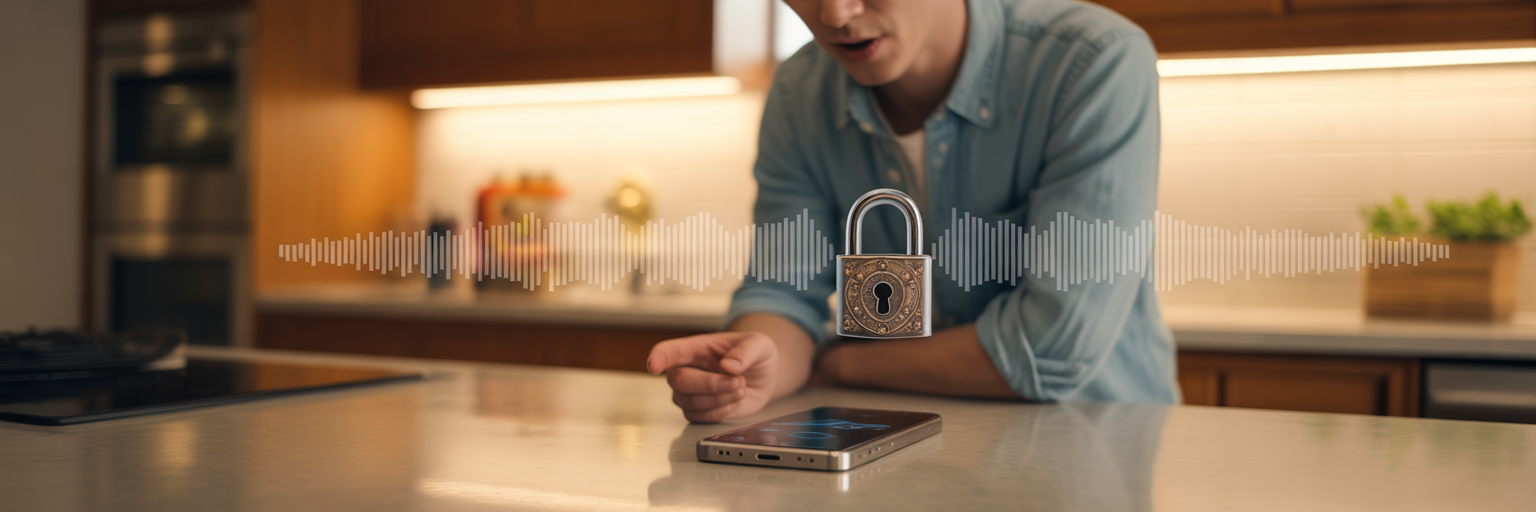
We’ve all heard the stories of data breaches and personal information being sold to third parties. When your meal logs contain sensitive health data, privacy isn't just a feature; it's a necessity. The distinction between on-device and cloud-based processing is central to understanding how your information is handled.
On-Device vs. Cloud-Based Processing
Many apps send your voice commands to a server for transcription. This means your raw audio and the resulting meal data travel across the internet and are stored on company computers. This approach exposes your information to potential security risks, from server hacks to internal policy changes on data usage.
In contrast, a true private nutrition tracker processes everything locally. It uses your phone’s built-in speech-recognition engine to understand what you said. Your voice data is transcribed directly on your device and is never sent to an external server. Your meal logs, preferences, and trends are stored in an encrypted database that only you can access. This commitment to security is central to our philosophy, ensuring your dietary habits remain your own.
The Principle of Data Minimization
Beyond where your data is stored, a privacy-first approach is also about what data is collected in the first place. Data minimization is the principle of collecting only what is absolutely necessary. A secure app will request minimal permissions, such as access to the microphone for voice input, but nothing more. It refrains from collecting analytics, diagnostics, or other usage metrics that track your behavior.
This approach gives you complete ownership and control over your information. There are no accounts to create and no personal details to hand over. Your nutrition data belongs to you and stays with you, on your device.
| Feature | On-Device Processing | Cloud-Based Processing |
|---|---|---|
| Data Storage | Locally on your device, encrypted | On company servers, often in the cloud |
| Privacy Risk | Minimal; no data transmission | Vulnerable to server breaches and data sharing |
| Internet Requirement | Not required for logging | Required for logging and access |
| User Control | Full control and ownership of data | Data is controlled by the service provider |
Note: This table contrasts the fundamental architectural differences that impact user privacy. On-device processing inherently limits data exposure by design, while cloud-based models require users to trust the provider's security and privacy policies.
Mastering Voice Logging for Accurate Calorie Counts
With the privacy concerns addressed, the next question is usually about accuracy. After all, speech recognition isn't always perfect, and for effective low calorie meal plan tracking, precision is critical. As research in journals like Nutrients highlights, even small variances in reported portion sizes can impact the effectiveness of a diet, making accuracy non-negotiable. Fortunately, you can significantly improve the precision of voice logging with a few simple techniques.
Speaking with Clarity and Structure
The key to accurate voice logging is to speak in a way the algorithm can easily understand. Adopting a consistent format helps the system parse your entries correctly. Here are a few best practices:
- Start with the quantity. Always begin with the portion size, whether it's a measurement like "one cup" or a count like "two slices."
- State the food item clearly. Be specific. Instead of just "chicken," say "six ounces of grilled chicken breast."
- Add meal context if you like. You can add "for lunch" or "for a snack" at the end to keep your log organized.
You can also log an entire meal in a single, structured phrase. For example: "For breakfast, I had two scrambled eggs, a slice of whole-wheat toast, and half an avocado." This structure turns a complex meal into a simple, parsable sentence.
The Importance of the Verification Step
Even with perfect structure, you should always confirm the entry. A well-designed app will display a transcript of what it heard, giving you a chance to review and correct any mistakes before saving the log. This quick check takes only a second but ensures your data is completely accurate.
This immediate feedback loop is crucial for getting the accurate nutrition data you need to stay on track with your goals. This level of precision is part of a larger trend, where advances in AI for personalized health are transforming how we monitor our bodies and make informed decisions.
The Freedom of Tracking Nutrition Anywhere

One of the most practical benefits of on-device processing is the ability to log meals without an internet connection. When you use an offline calorie tracker app, your entries are saved securely on your device the moment you speak them. The nutritional data is processed once you're back online, but the log itself is captured instantly. This capability is invaluable in many real-world scenarios:
- Commuting on a subway or train with spotty service.
- Hiking, camping, or traveling in remote areas without a signal.
- Being on a flight or in a large building with poor reception.
- Simply wanting to log a meal quickly without waiting for an app to connect.
This freedom is directly linked to consistency. For anyone on a low-calorie diet, forgetting to log a snack or a meal can throw off an entire day's calculations. The ability to track a meal the moment you eat it, regardless of internet access, prevents those gaps and ensures your daily totals remain accurate. It removes a major barrier to consistent tracking, making it easier to stick with your plan.
For those committed to their health goals, the ability to how to track macros without internet dependency is a significant advantage. You can experience seamless offline tracking and see how it transforms your daily routine.