

Most of us have been there. You download a nutrition app, full of motivation to get your diet on track. For a few days, you diligently log every meal. But soon, the process starts to feel like a second job. This friction, often called "logging fatigue," is the main reason people abandon their nutrition goals. It’s not a lack of willpower, but a failure of the tools we use.
Beyond Manual Calorie Counting
Traditional meal logging is a tedious process. We can all picture that moment, phone in one hand, fork in the other, scrolling through an endless database for "chicken breast, grilled, no skin." You make a guess on the portion size, tap through a few more screens, and repeat the entire cycle for the side of broccoli and rice. By the time you’re done, your food is cold and your motivation has cooled with it.
This manual approach is riddled with frustrations that undermine consistency. The data becomes unreliable, and progress stalls. The core issues often come down to a few key problems:
- The time-consuming search for individual ingredients in massive, often inaccurate, databases.
- The guesswork involved in estimating portion sizes, leading to unreliable calorie and macro counts.
- The repetitive data entry for every meal and snack, which quickly feels like a chore rather than a helpful habit.
These small points of friction add up, turning a tool meant to empower you into a source of daily annoyance. It becomes clear that for nutrition tracking to be sustainable, it needs to be far more intuitive. It needs to fit into our lives, not disrupt them. This is where a more intelligent approach becomes essential.
How Artificial Intelligence Streamlines Meal Entries

Building on the need for a smarter solution, artificial intelligence transforms meal logging from a rigid, structured task into a simple conversation. Using Natural Language Processing (NLP), an AI nutrition tracker understands how people actually talk about food. Instead of searching for items one by one, you can describe your entire meal in a single sentence.
For example, imagine just saying or typing, "I had a bowl of oatmeal with a handful of almonds and a drizzle of honey." The AI parses this sentence, identifies each component, and intelligently interprets descriptive quantities like "handful" and "drizzle" to calculate the nutritional information instantly. This is a world away from the old method of manually searching for oatmeal, then almonds, then honey, and guessing at the amounts for each.
This conversational input dramatically reduces the mental load and time required to log a meal. What once took several minutes of focused effort now takes seconds. By turning a complex task into a simple conversation, a modern AI nutrition tracker makes it far easier to stay on top of your dietary goals. Over time, these systems can even learn your eating habits, anticipating your common meals to make logging even faster. The practical differences are stark.
| Feature | Manual Logging | AI-Powered Logging |
|---|---|---|
| Data Entry | Manual search and selection for each item | Natural language input (text or voice) |
| Time per Meal | 3-5 minutes | Under 30 seconds |
| Portion Estimation | Relies on user guesswork | Interprets descriptive quantities (e.g., 'a handful') |
| Consistency | Prone to 'logging fatigue' and missed entries | Low friction encourages daily, consistent use |
This table illustrates the practical differences in user experience and data quality between traditional manual logging and modern AI-driven methods.
Logging Your Meals by Simply Speaking
While conversational text entry is a major improvement, voice meal logging represents the peak of frictionless tracking. For most people, speaking is faster and more natural than typing. It allows you to capture what you ate in the moment, without breaking your flow. This hands-free capability is more than just a convenience; it integrates nutrition tracking seamlessly into a busy life.
Consider these common scenarios where voice input makes all the difference:
- Logging ingredients hands-free while you are cooking, without having to wash your hands to handle your phone.
- Recording a post-workout shake at the gym without stopping your routine or fumbling with a sweaty screen.
- Capturing meal details while driving or commuting, ensuring you don't forget what you ate by the time you get home.
This is why a fast calorie counter app with voice control is so effective. It removes the final barrier between thinking about a meal and recording it. As a TechCrunch report highlights, the integration of voice is a key trend in making consumer health apps more accessible and intuitive. Furthermore, this technology offers significant accessibility benefits, empowering individuals with mobility or visual impairments to manage their nutrition with the same ease as anyone else.
Turning Food Logs into Meaningful Feedback
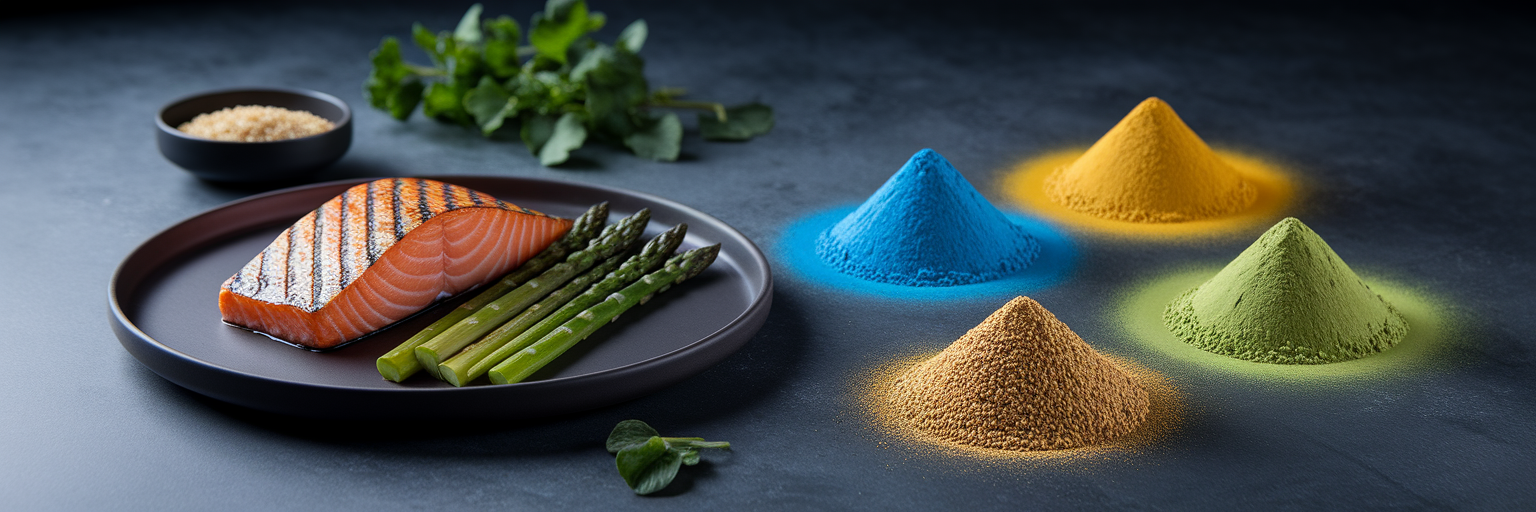
The real purpose of tracking your food isn't just to create a list of what you've eaten. It's to understand the nutritional impact of your choices. This is where an AI-powered system truly shines, moving beyond simple data entry to provide immediate, intelligent analysis. As soon as you log a meal, you see a complete breakdown of its calories and macronutrients, creating a powerful feedback loop.
This instant connection between a food choice and its outcome fosters mindful eating. For instance, you might log your lunch and notice it was lower in protein than you thought. Armed with that insight, you can consciously choose a protein-rich snack later in the afternoon to meet your goals. This is how to track macros easily and effectively, not by doing complex math, but by reacting to clear, immediate feedback.
Beyond single meals, an AI tracker can identify patterns over weeks and months that would be nearly impossible to spot on your own. It might highlight that you consistently hit your fiber targets on weekdays but fall short on weekends, or that your sodium intake tends to be highest on days you eat out. This immediate analysis transforms raw data into actionable knowledge, helping users make smarter dietary choices throughout the day and understand their patterns over time. The goal is not just to log data, but to learn from it.
Your Nutrition Data Should Belong to You
In an age where personal information is constantly being collected and monetized, it's reasonable to ask: where does my sensitive health data go? Many apps transmit your meal logs, health stats, and personal details to the cloud, where they are stored on company servers. This practice creates significant privacy risks.
We believe your nutrition data is yours alone. The solution is on-device AI processing, a cornerstone of private nutrition tracking. This architecture ensures that everything from your voice commands to your meal history is processed and stored in an encrypted database directly on your phone. Nothing is ever sent to a server. No accounts are needed, and your identity remains completely anonymous.
As noted in a WHO report on AI in healthcare, maintaining user trust through robust data protection is essential for the adoption of digital health tools. Privacy should not be a feature you pay extra for; it should be the default. By processing all data locally, the risk of data breaches or misuse is eliminated. Ultimately, the most advanced technology empowers users without compromising their fundamental right to privacy.