

You are standing on a street in a new city, the air filled with the scent of unfamiliar spices and freshly baked bread. The desire to try everything is strong, but so is the commitment to your health goals. This tension is a familiar part of travel for anyone who tracks their nutrition. It is not a failure of willpower, but a natural challenge of balancing exploration with discipline.
Beyond the food itself, a modern digital risk emerges. We have all connected to that free airport or café Wi-Fi to quickly log a meal. Yet, many health apps send your personal information—what you eat, when you eat, and where you are—to the cloud over these unsecured networks. This exposes sensitive data to potential interception.
Then there is the mental fatigue. Manually searching for ingredients in a foreign dish or guessing portion sizes from a photo you took hours ago pulls you out of the moment. It turns a joyful experience into a chore. These are common frustrations, but there are better ways to approach healthy travel eating tips without compromising your goals or your privacy.
The solution lies in a privacy-first approach. Imagine a tool that lets you track your meals instantly and accurately, without ever sending your data to a server. This method resolves the dilemma, letting you stay on track while keeping your personal information exactly where it belongs: with you.
Why Data Privacy Matters More on the Road
When you are traveling, your digital vulnerability increases. Using a typical health app on public Wi-Fi is like sending a postcard. Anyone who cares to look can read the contents because the information is exposed. In contrast, an app that processes data on your device is like sending a sealed, encrypted letter. The contents are for your eyes only.
Most nutrition apps store your meal logs, health metrics, and even your location on company servers. This cloud-based data becomes a target for breaches. When your dietary habits are combined with your travel patterns, it creates a detailed personal profile that is highly valuable to marketers and bad actors. You are not just sharing that you ate a croissant; you are sharing that you ate a croissant at a specific café in Paris on a Tuesday morning. This is your digital footprint, and it is larger than you think.
This is why on-device processing is the gold standard for a secure calorie tracker. With this method, all calculations and data storage happen directly on your phone. Your personal information never leaves your device, which makes the security of the Wi-Fi network irrelevant. A truly private nutrition tracker operates without needing your data, effectively eliminating the risk of network interception or company data breaches. It is a conscious choice to keep your health journey private, especially when you are far from home.
| Feature | Standard Cloud-Based App | Privacy-First On-Device App |
|---|---|---|
| Data Storage | On company servers, often unencrypted | Locally on your device, encrypted |
| Network Dependency | Requires internet to log and sync | Works fully offline |
| Privacy Risk | Vulnerable to data breaches and server-side snooping | Immune to network interception and data breaches |
| Account Requirement | Mandatory account creation, linking personal identity | No account needed, ensuring anonymity |
Practical Strategies for Logging Meals On-the-Go

Maintaining consistency with nutrition tracking while traveling depends on making the process as simple as possible. The less friction there is, the more likely you are to stick with it. Modern tools offer efficient ways to log meals that fit seamlessly into your travel rhythm.
Use Voice for Speed and Discretion
Picture this: you have just finished a delicious meal and are heading to your next destination. Instead of stopping to type, you can simply speak into your phone. A voice food logging app allows you to capture the meal in seconds. Saying, “I had a bowl of New England clam chowder and a side salad with vinaigrette,” is faster and more natural than navigating menus and databases. It is discreet enough to do while walking and ensures you capture the details while they are fresh in your mind, letting you get back to enjoying your trip.
Use Text for Quiet Environments
Of course, there are times when speaking is not practical. In a quiet museum, a fine-dining restaurant, or late at night in a shared room, text logging offers the same speed with added flexibility. A quick note like “two scrambled eggs, bacon, and a slice of toast” is all it takes. The goal is to have a tool that adapts to your environment, not the other way around. A well-designed privacy first nutrition app makes switching between voice and text effortless.
Log Instantly for Maximum Accuracy
We have all tried the "log it later" method. You take a photo of your meal, promising to enter it at the end of the day. But later, you are tired, and the details become fuzzy. Was that dressing oil-based or creamy? How big was that portion, really? Instant logging removes the guesswork. When you log a meal right after eating, your memory is sharpest. For unfamiliar dishes, you do not need to know every ingredient. Simply describe it, for example, “a slice of deep-dish pizza with sausage and peppers.” A smart app can interpret that description and provide a reliable nutritional estimate. For a quick portion size estimate, you can use your hand as a guide—a practice detailed by nutrition experts at Harvard T.H. Chan School of Public Health.
Setting Yourself Up for a Healthy Trip
Success with nutrition tracking while traveling begins before you even leave home. It is about setting realistic expectations and preparing yourself with the right mindset and tools. Perfection is not the goal; consistency is. A single indulgent meal does not derail your progress, but giving up entirely might.
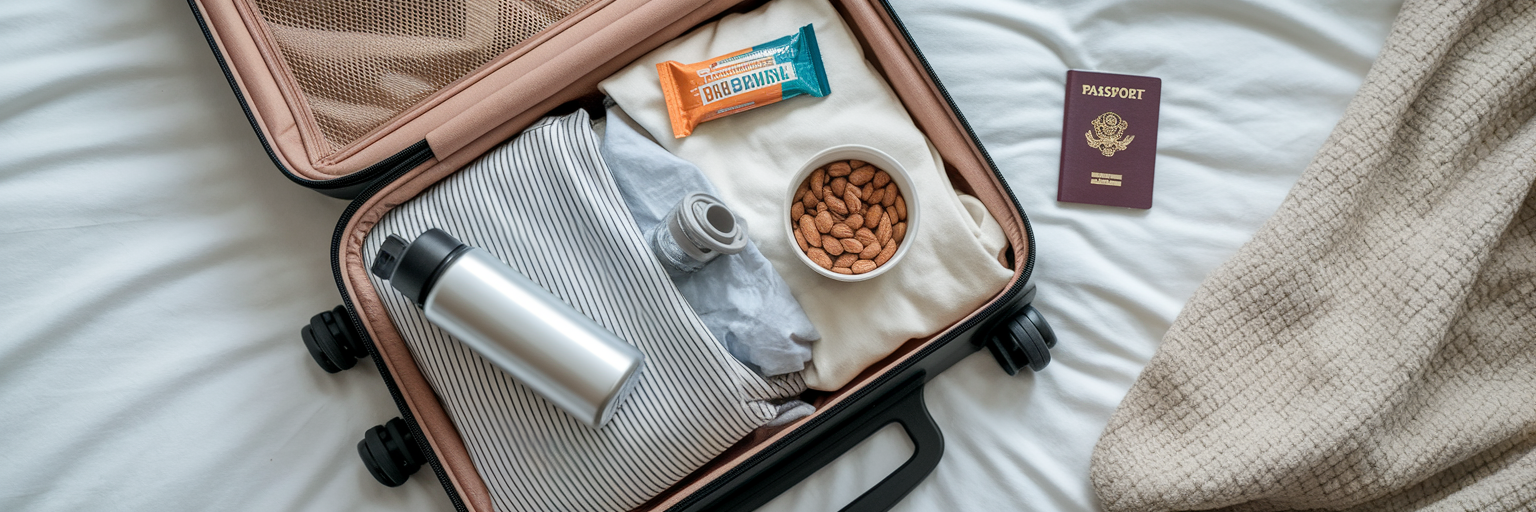
One of the best strategies for how to log food on vacation is to control what you can. Packing smart, non-perishable snacks helps you avoid making impulsive, unhealthy choices when you are hungry at an airport or between meals. Having healthy options on hand empowers you to stay on track.
Consider packing a few of these items:
- Individually packed protein bars or powders
- Single-serving bags of almonds, walnuts, or trail mix
- Beef or turkey jerky
- Dried fruit without added sugar
- A reusable water bottle to stay hydrated
Staying hydrated and prioritizing protein are also simple but effective ways to manage appetite and maintain energy levels throughout the day. Before you depart, take a few minutes to research the area where you will be staying. A quick search for nearby grocery stores or restaurants with healthy options can make a huge difference. This proactive approach helps you feel prepared and in control. The final step is to equip yourself with the right tool. You can get started with our privacy-first tracker before you leave to ensure you are ready from day one.
Your Privacy-First Travel Checklist
Staying true to your health goals while exploring the world should be empowering, not stressful. With the right approach, you can enjoy your travels without sacrificing your progress or your personal data. Here is a simple checklist to keep you on track.
- Choose an on-device app. Your first line of defense is a tool that stores and processes all your data locally. This ensures your information stays private, regardless of what network you are on.
- Use efficient logging methods. Embrace the speed of voice and text logging to capture meals instantly and accurately. Make tracking a seamless part of your day, not a distraction from it.
- Prepare for success. Set realistic goals, pack smart snacks to manage hunger, and do a little research on your destination’s food scene before you go.
As an added layer of security, consider using a VPN on public Wi-Fi. This encrypts all your internet traffic, protecting not just your health data but everything you do online. With these strategies, you can confidently focus on what matters most: your health and the joy of your journey.