

Why Voice Logging is Perfect for Intermittent Fasting
Intermittent fasting brings a welcome structure to eating by focusing on *when* you eat, not just what. Yet, the discipline required to maintain a fasting schedule often clashes with the tedious task of logging every meal during your eating window. We’ve all been there: you’ve just finished a meal, and the last thing you want to do is pull out your phone to type, search, and quantify every single ingredient.
Within a condensed eating window, convenience is everything. The easier it is to track your food, the more likely you are to do it consistently. This is where the power of your own voice comes in. Think of manual logging as filling out a detailed form for every meal. In contrast, voice logging for diet is like having a quick conversation. Simply speaking what you ate—"a bowl of oatmeal with blueberries and a scoop of protein powder"—is significantly faster than navigating menus and keyboards.
This low-effort method helps build better habits. When logging is frictionless, you capture more complete and accurate data. You are less likely to skip logging that handful of almonds or the splash of cream in your coffee. In fact, natural speech often includes more detail than a quickly typed entry. These small details are essential for precise intermittent fasting nutrition tracking, ensuring your efforts align with your health goals.
Choosing the Right Voice-Enabled Nutrition App

Now that the advantage of voice logging is clear, the next step is selecting the right tool. Not all apps that claim to support voice input are built the same, and the differences in functionality and privacy can be significant.
Look for Native Voice Functionality
Some apps simply use your phone’s built-in assistant, like Siri or Google Assistant, to capture text. This can feel clunky, requiring you to switch between apps or use awkward command phrases. A truly effective tool has its own native voice recognition built directly into the app. This integration provides a streamlined, reliable experience designed specifically for nutrition logging. It understands food-related terms and quantities without extra setup, making the process feel seamless and immediate.
Prioritize Data Privacy and Security
Perhaps even more important than functionality is how an app handles your personal information. Before downloading any health tracker, ask yourself a few critical questions. Does the app require you to create an account? Is your meal history stored on a company’s server? Is your data being shared with or sold to third parties? Many people are surprised to learn that their eating habits are being collected and analyzed by companies they've never heard of.
The highest standard for security is on-device processing. This means all your data, from your meal logs to your nutrition trends, is stored and managed exclusively on your phone. It never leaves your device. When you choose a private nutrition tracker app that enables food logging without an account, you are ensuring your sensitive health information remains exactly where it belongs: with you. This approach empowers you to make an informed choice that protects your privacy.
A Step-by-Step Guide to Logging Meals by Voice
Adopting voice logging is straightforward. With a few simple habits, you can ensure your nutrition data is both accurate and useful. Here is a practical guide to get you started.
- Be Specific: The more detail you provide, the more accurate your nutritional summary will be. Instead of saying "chicken salad," describe its key components. Your voice makes it easy to capture these details without extra effort.
- State Quantities: Use common measurements whenever possible. Phrases like "one cup," "two tablespoons," or "six ounces" give the app the information it needs to calculate calories and macros precisely. You can also use natural language like "a handful" or "a small bowl."
- Log Immediately: The speed of voice logging makes it practical to record your meal right after you finish eating. This simple habit prevents you from forgetting ingredients or misremembering portion sizes later in the day.
- Review Daily: Take 30 seconds at the end of your eating window to quickly scan your entries. This ensures everything was captured correctly and gives you a clear picture of your day’s intake before your fast begins.
To see how this works in practice, consider the difference between vague and specific entries.
| Vague Entry | Specific Entry | Why It Matters for Accuracy |
|---|---|---|
| 'Chicken salad for lunch' | '6 ounces of grilled chicken breast with 2 cups of mixed greens and 1 tablespoon of olive oil vinaigrette' | Provides precise protein, fat, and calorie data. |
| 'Morning coffee' | 'A large black coffee with 2 tablespoons of heavy cream' | Accurately captures added fats and calories. |
| 'A protein shake' | 'One scoop of whey protein powder with 8 ounces of unsweetened almond milk' | Differentiates between protein sources and liquid bases. |
| 'An apple' | 'One medium-sized Honeycrisp apple' | Accounts for variations in size and sugar content among fruit types. |
Note: These examples show how small details in your voice log can significantly improve the accuracy of your calorie and macronutrient calculations.
Using Your Data to Optimize Fasting Goals
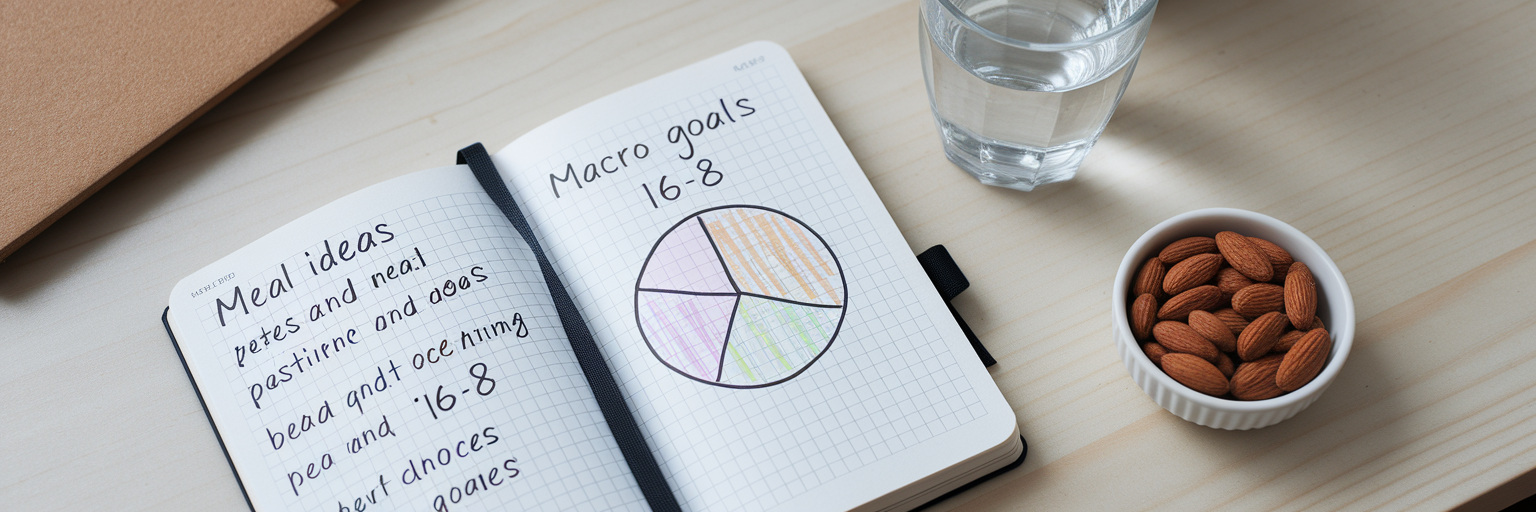
Accurate data collection is just the first step. The real value comes from using that information to refine your approach and achieve your specific goals. Moving beyond simple calorie counting allows you to make strategic adjustments based on what your body needs.
This is where learning how to track macros for fasting becomes powerful. Are you trying to maintain muscle mass? Consistent logging helps you ensure your protein intake is sufficient within your eating window. Are you focused on metabolic health? Tracking your carbohydrate and fat intake can help you fine-tune your diet to support your goals. This data makes it clear whether you are in a calorie deficit for weight loss or a surplus for muscle gain.
Over time, you will start to notice personal patterns. You might discover that certain meals provide sustained energy throughout your fast, while others lead to an afternoon slump. Combining this nutritional data with a fasting timer gives you a complete picture of your IF lifestyle. Of course, data is just one tool. It is also important to listen to your body. While intermittent fasting is effective for many, it is not a universal solution. In fact, research from the National Institutes of Health suggests that very long daily fasts may not be suitable for everyone, reinforcing the importance of mindful and informed tracking.
Why Your Nutrition Data Deserves On-Device Privacy
Your daily food log is more than just a list of meals. It is a detailed record of your habits, health choices, and lifestyle. In an era where personal data is routinely collected and monetized, the question of who controls this information is more important than ever. Cloud-based health apps often come with hidden risks.
- Data Breaches: When your health history is stored on a remote server, it becomes a target for breaches, potentially exposing sensitive information.
- Data Selling: Many companies aggregate user data and sell it to advertisers, insurance companies, and other third parties without your explicit knowledge.
- Permanent Records: Your data can be used to build a permanent profile of your habits, completely outside of your control.
There is a better way. A privacy-by-design approach ensures your information never leaves your device. With on-device processing, there are no accounts to create, no server syncs, and no data transfers. Your nutrition log remains yours alone. Choosing an app is an act of data ownership. Look for companies that are transparent about their practices and demonstrate a commitment to privacy-by-design. Your health journey is personal, and the data it generates should remain private.