

The Challenge of Nutrition on the Road
We all know the feeling. You’ve spent weeks dialing in your nutrition, only to have your routine disrupted by a trip. Most of us dine out more frequently on vacation, which makes managing calories and macros a constant guessing game. The unfamiliar menus, the social pressure to indulge, and the sheer lack of routine can make even the most disciplined person feel like they are starting from scratch.
This is where traditional tracking methods often fall short. We can all picture that moment: you are trying to enjoy a meal with friends, but instead, you are hunched over your phone, endlessly scrolling through a database to find an entry that vaguely matches what is on your plate. The process is slow, distracting, and frankly, impractical when you are supposed to be relaxing.
This friction is why so many of us abandon tracking while traveling. It just feels like too much work. But what if you could capture every detail of your meal in the time it takes to describe it? That is the promise of voice logging. Instead of getting lost in a complex app interface, you simply speak your meal into existence. This simple shift makes consistency not just possible, but effortless, allowing you to stay on track without sacrificing the spontaneity of your travels.
Essential Pre-Trip Nutritional Planning

With the challenges of on-the-road nutrition in mind, a little preparation can make all the difference. Taking proactive steps before you even pack your bags empowers you to maintain control without sacrificing enjoyment. Start by researching your destination’s food environment. A quick search on a map can reveal nearby grocery stores for stocking up on healthy staples, and many restaurants now post their menus online, allowing you to identify macro-friendly options in advance.
Packing smart snacks is another non-negotiable. Having reliable options on hand prevents you from making impulsive choices when hunger strikes during a long flight or a day of sightseeing. Focus on portable, non-perishable items that offer a good balance of nutrients.
- Protein bars or jerky for a quick and satisfying protein source.
- Single-serving nut or seed packets to provide healthy fats and curb cravings.
- Dehydrated fruit for a simple carbohydrate boost without added sugar.
- Individual protein powder packets that you can easily mix with water.
This preparation helps you build a flexible meal framework, not a rigid plan. The goal for how to track macros while traveling is consistency, not perfection. As WebMD points out, simple strategies like asking for sauces and dressings on the side can significantly reduce hidden calories when dining out. Adopting this mindset before you leave allows you to navigate new food landscapes with confidence, balancing your health goals with the pleasure of experiencing new cuisines.
Mastering On-the-Go Meal Logging with Voice
Once your trip is underway, the key to success is capturing what you eat accurately and immediately. This is where the mechanics of voice logging truly shine, turning a tedious task into a seamless habit.
Log Meals Immediately for Maximum Accuracy
How many times have you forgotten to log a snack or a drink, only to struggle to remember the details hours later? Memory is notoriously unreliable. Voice logging closes this gap by making it possible to record your meal the moment you finish it. Whether you are stepping out of a restaurant or finishing a snack on a park bench, a quick voice entry takes seconds and ensures nothing gets missed. This immediacy is the foundation of accurate tracking.
Use Specific Commands to Capture Detail
The quality of your tracking data depends on the detail you provide. Vague entries lead to vague results. Effective voice logging for nutrition is about being descriptive. Instead of saying, "I had a chicken salad," a more powerful entry would be: "a grilled chicken salad with romaine lettuce, tomatoes, cucumbers, and about two tablespoons of vinaigrette dressing." This specificity allows for a much more precise macro calculation, giving you a clearer picture of your intake.
Estimate Portion Sizes with Confidence
When you are traveling, you will not have a food scale in your pocket. This is where visual estimation becomes an essential skill. Using your hand as a guide is a simple yet effective way to gauge portion sizes without any tools. It is a universal method that works for any meal, in any country.
| Food Component | Hand Comparison Guide | Visual Example |
|---|---|---|
| Protein (Meat, Fish, Tofu) | One palm | A deck of cards |
| Dense Carbs (Rice, Pasta, Potatoes) | One cupped hand | A tennis ball |
| Fats (Oils, Butter, Dressing) | One thumb | A poker chip |
| Vegetables or Fruits | One fist | A baseball |
Note: This table provides a simple, universally applicable method for estimating portion sizes without a scale, ideal for travelers. These are general estimates and can be adjusted based on hand size.
By combining immediate logging, descriptive commands, and confident portion estimation, you create a powerful and sustainable tracking habit. This frictionless experience, like the one we designed at Saylo AI, ensures you spend less time logging and more time enjoying your trip.
Decoding International and Unfamiliar Cuisines
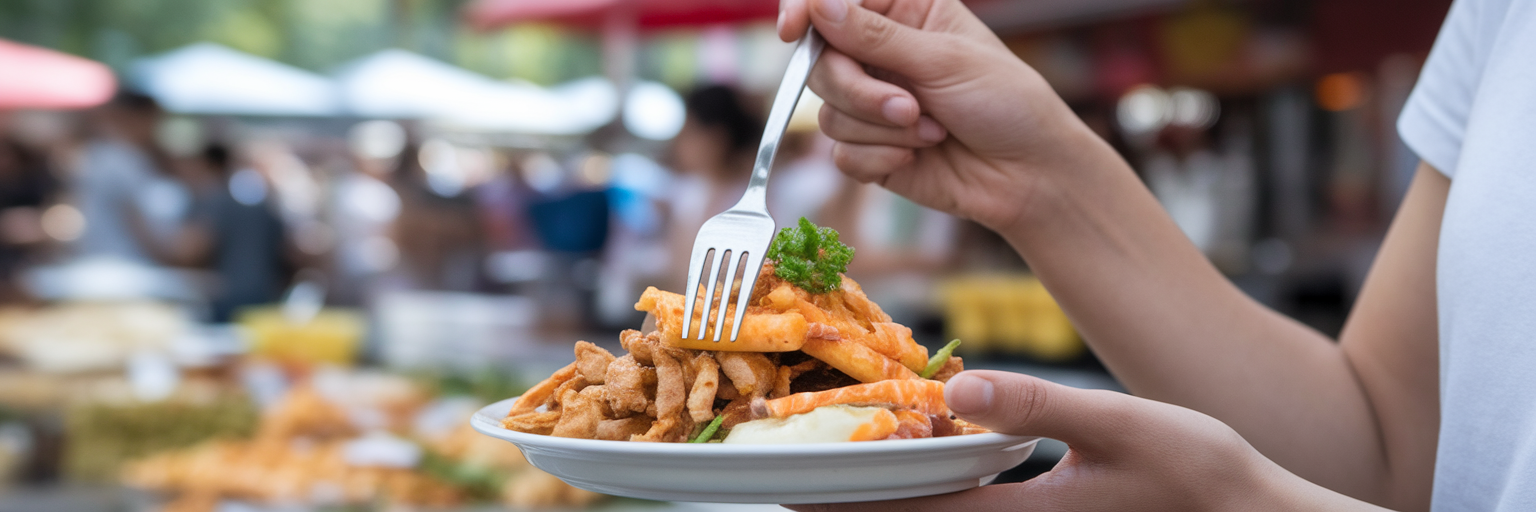
Navigating foreign menus is one of the most exciting parts of travel, but it can present a unique challenge for tracking macros on vacation. When you encounter a dish with unfamiliar ingredients, the key is to deconstruct it using a "first principles" approach. Instead of getting overwhelmed by the name of the dish, break it down into its fundamental components: what is the primary protein, what is the carbohydrate source, and where are the fats coming from?
A bowl of pho, for example, can be logged as rice noodles (carbs), beef or chicken (protein), and broth. Sauces and oils are often the biggest sources of hidden calories. If possible, ask for them on the side. If not, visually estimate the amount using the thumb-as-a-tablespoon rule. When in doubt, lean on simple, whole foods that are easy to identify, like grilled fish, steamed vegetables, or fresh fruit. These are often available on menus worldwide and provide a reliable nutritional baseline.
It is also valuable to practice a bit of cultural observation. Pay attention to how locals eat. Are their portion sizes smaller than what you are used to back home? This can provide important context for your estimations. The goal is not to achieve flawless accuracy with every exotic meal but to make an informed estimate. By breaking down complex dishes into their core macros, you can get the accurate, immediate nutrition insights you need to stay on course, even when the menu is in another language.
Maintaining Consistency Without Internet Access
Travel often takes us to places with unreliable or nonexistent internet. Think of long flights, remote hiking trails, or simply trying to avoid expensive international data roaming charges. For most nutrition apps, this is a dealbreaker. If an app relies on a constant connection to a server, it becomes useless the moment you go offline. This forces you to either jot down notes and log everything later or, more likely, give up on tracking for the day.
This is where the architecture of your tracking tool becomes critical. An offline macro tracking app that processes everything on your device is the only way to guarantee uninterrupted logging. With on-device processing, your voice commands are interpreted and your meals are logged instantly, whether you are at 30,000 feet or in a subway tunnel. There is no waiting for a signal and no need to rely on memory.
This capability removes internet access as a variable in your tracking consistency. While cloud-dependent apps fail without a connection, an offline-first approach ensures your tool is always ready when you are. It empowers you to maintain your routine and capture every meal, no matter where your travels take you.
The Privacy Advantage of On-Device Tracking Abroad
Beyond just functionality, there is a crucial security reason to be mindful of your apps while traveling. Connecting to public Wi-Fi at airports, cafes, and hotels is convenient, but it also exposes your personal data to significant risks. Many apps transmit sensitive information, including your health and nutrition logs, to external servers, creating a vulnerability that can be exploited on unsecured networks.
Using a private nutrition tracker that operates entirely on-device acts as a form of digital self-defense. When your app stores all data locally in an encrypted database and requires no account to function, your information never leaves your phone. It is shielded from potential data breaches and is never accessible to anyone but you.
This privacy-first design provides invaluable peace of mind. While you focus on exploring a new city or relaxing on a beach, you can be confident that your personal health data is not being collected, analyzed, or shared. It allows you to track your nutrition with the complete confidentiality you deserve, using a tracker that keeps your data yours alone.